
This post contains some affiliate links
Friends,
Myths, Magic, Mayhem, and more…
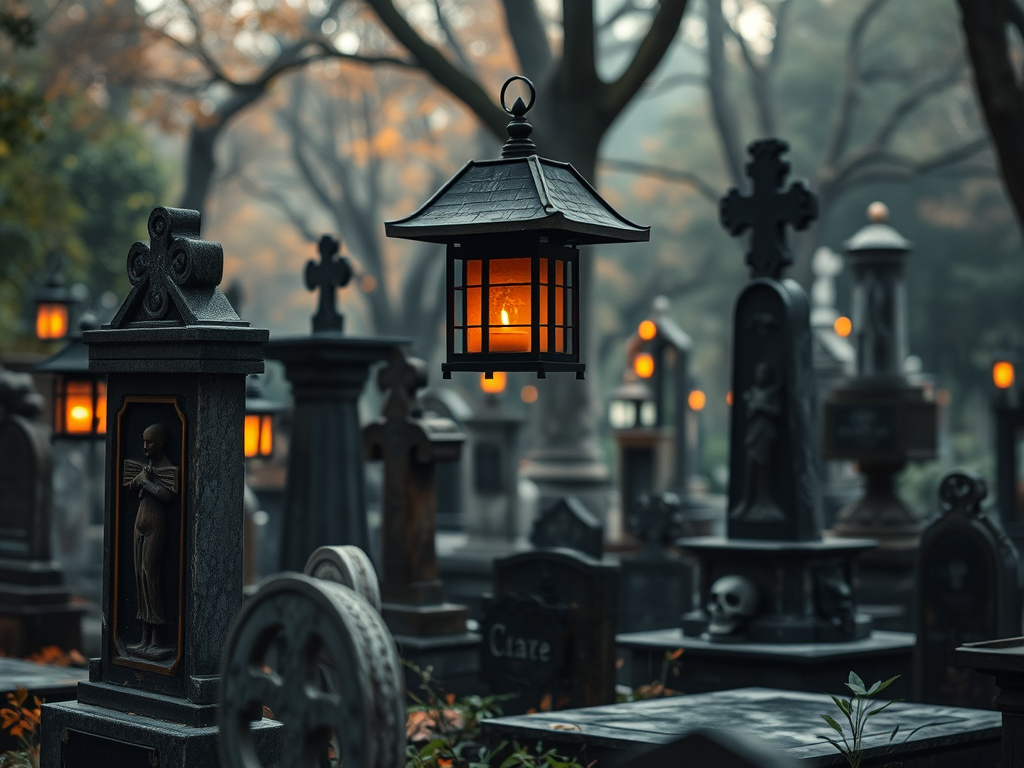
Now, I will begin by saying that some of my fondest childhood memories are of my mother taking me to random graveyards. We would walk through the rows, paying attention to who had married whom. Noting the dates and paying our respects to those whose lives were lost too early. We would connect the dots and talk about wars, diseases, and any of the other hundred moments in history represented by the gravestones.
Graveyards are an excellent way to remember and honor history and those who have passed away.
I learned at an early age that there was beauty in death.
Ironically, I don’t want to be buried.
However, during my years of research and travel, I have encountered some beautiful graveyards, as well as those with a unique and striking character.
Okunoin Cemetery, Japan
Okunoin is the site of the mausoleum of Kobo Daishi, the founder of Shingon Buddhism, and is considered one of the most revered persons in the religious history of Japan. Kobo Daishi is believed to be in eternal meditation, awaiting Miroku Nyorai (Maihreya), the Buddha of the Future, and to provide relief to those who seek salvation. Okunoin is one of the most sacred places in Japan and a popular pilgrimage destination.

While there, take a moment to stop by Torodo Hall (Hall of Lamps) and be amazed by more than 10,000 lanterns donated by worshipers, lit eternally. In the basement are 50,000 statues donated to commemorate the 1150th anniversary of Kobo Daishi’s eternal meditation.
Neptune Memorial Reef, Key Biscayne, Florida

Columns guarded by carved lions welcome the dead to their final resting place. The kicker? It’s 40 feet underwater, with stone roads, soaring gates, and crumbling ruins.
Originally named the Atlantis Memorial Reef, the lost city is part of an underwater cemetery that also acts as an artificial reef, sponsored by the Neptune Society, a cremation company. Located about 3 miles off the coast of Key Biscayne in Miami, the undersea cemetery was designed by Florida artist Kim Brandell and opened in 2007.
If you’re worried about visiting, don’t! There are plenty of companies that offer scuba-diving excursions, and it’s a popular area for boaters.
The Merry Cemetery, Romania
In the town of Săpânţa, Romania, the Merry Cemetery features over 800 wooden crosses that bear the life stories, intimate details, and final moments of the individuals they commemorate. Displayed in bright, cheery pictures and annotated with limericks are the stories of nearly every deceased citizen.

How did this come to be? Interestingly, it was one man. Stan Ioan Pătraş was born in Săpânţa in 1908; by the age of 14, he had already begun carving crosses for the local cemetery. By 1935, Pătraş had begun carving clever or ironic poems about the deceased in a rough local dialect, including portraits and descriptions of their deaths.
Underneath this heavy cross
Epitaph in the Merry Cemetery
Lies my mother-in-law poor
Had she lived three days more
I would be here and she would read / You that are passing by / Try not to wake her up
For if she comes back home
She’ll bite my head off / But I will act in the way
That she will not return
Stay here my dear
Mother-in-law.
The Old Jewish Cemetery, Prague
The Old Jewish Cemetery is not the first Jewish cemetery in Prague – its predecessor was the ‘Jewish Garden’ in the present-day New Town. This cemetery was closed by order of King Vladislaus II in 1478 because of complaints from Prague citizens. Later, it disappeared under the streets of New Town.
It is unclear when exactly the Old Jewish Cemetery was founded, but the oldest gravestone, that of Rabbi and poet Avigdor Kara, is dated to 1439.
Because Jewish custom doesn’t allow for the abandonment of old graves, and the community wasn’t allowed to purchase grounds to expand the cemetery, a considerable number of graves were crammed into a relatively small space.

There are around 100,000 bodies buried there, many of which are marked under various gravestones, denoting that the bodies are stacked 12 deep in many places. As a result, the cemetery’s surface rises several meters above the surrounding streets.
Arlington National Cemetery, U.S.
Arlington National Cemetery, the most famous cemetery in the United States, is the final resting place for many of our nation’s greatest heroes, including more than 300,000 veterans of every American conflict, from the Revolutionary War to the conflicts in Iraq and Afghanistan.
It contains the remains of more than 300,000 veterans in 70 burial sections and 38,500 remains in the eight columbariums. Section 27 contains the remains of more than 3,800 former slaves who resided in the Freedman’s Village on the cemetery grounds. Freed slaves were allowed to farm on this land from 1863 to 1883, and those who died while residing in the village were buried there.

The most visited area is the Tomb of the Unknown– a burial vault containing the remains of three unidentified service members, one each from World War I, World War II, and the Korean War. A white marble sarcophagus sits atop the vaults facing Washington and is inscribed with three Greek allegorical figures representing Peace, Victory, and Valor.
Nameless but not forgotten
On Armistice Day in 1921, they laid to rest the nameless hero of the Great War. His body had journeyed across the Atlantic from the blood-soaked fields of France, pausing beneath the Capitol’s solemn dome where a grieving nation paid tribute.
Nearly four decades later, on Memorial Day of 1958, two more warriors without names joined him—one who fell amid the global flames of the Second World War, another claimed by the frozen hills of Korea. Each was honored with the nation’s highest military decoration before being committed to the sacred ground.
In 1984, a casket believed to hold an unidentifiable casualty of the Vietnam War received the Medal of Honor and found rest at the Tomb of the Unknowns. Fourteen years later, DNA testing returned this soldier’s name: Air Force 1st Lieutenant Michael J. Blassie. His remains left Arlington National Cemetery for a family plot in St. Louis, where at last he could be mourned by those who had always known exactly who he was.
Since then, the Vietnam vault has remained vacant.
The tomb is continuously guarded by the 3rd U.S. Infantry, the Army’s oldest active-duty infantry unit, also known as “The Old Guard.”
Final Thoughts
One of the most significant decisions we face as mortals is choosing where we want to spend eternity and how we want to be remembered. It’s an important decision, and I invite you to consider how other cultures honor their dead and make the choice that’s right for you.
“Every life holds an epic tale, even if no one alive remembers it.”
Greg Melville, Over My Dead Body: Unearthing the Hidden History of America’s Cemeteries
Until next time, Keep Reading and Stay Caffeinated.
Subscribe below to stay up to date on myths, legends, mysteries, and the chaos I call my life.

If you’re looking for your next favorite read, I invite you to check out my book, The Raven Society. This spellbinding historical fantasy series takes us on a heart-pounding journey through forgotten legends and distorted history. Uncover the chilling secrets of mythology and confront the horrifying truths that transformed myths into monstrous realities. How far will you go to learn the truth?
The Writer and The Librarian (Book 1):
Signed copies at:
https://rlgeerrobbins.com/product/the-writer-and-the-librarian-the-raven-society-book-1/
Explore more here:



What are your thoughts?