
This post contains some affiliate links
Friends,
The name Charles Lindbergh is forever etched in the annals of American history, not just for his audacious transatlantic flight in 1927 but also for the dramatic events surrounding the kidnapping of his infant son, Charles Jr., in 1932.
This case, often called “The Crime of the Century,” captivated the nation and raised questions about justice, media frenzy, and conspiracy.
A Tapestry Of Events
In 1930, America’s favorite flying heartthrob, Charles Lindbergh, and his equally adventurous wife, Anne Morrow, fled to Hopewell like a pair of celebrity fugitives. After Charles’ 1927 hop across the pond turned him into the Jazz Age equivalent of a rock star, the couple craved a place where reporters wouldn’t hide in their rosebushes.
They christened their woodland hideout “Highfields”—a name that sounds like something from a children’s book about talking rabbits—and proceeded to build their nest far from the madding crowd’s telephoto lenses and autograph books.

Why Hopewell? Well, picture this: it was as quaint as a button, with neighbors nosy enough to notice strangers but polite enough to pretend they hadn’t recognized the most famous fly-boy in America buying milk at the corner store. Perfect for raising little Charles Jr. in blissful, press-free obscurity.
Or so they thought.
1 March 1932
The evening began like any other. Charles and Anne were enjoying dinner, perhaps reflecting on their recent family trip and the joys of parenthood. Their son was in his nursery on the second floor. At around 8:30 p.m., Betty, the boy’s nanny, visited the nursery and found everything in order. The baby was peacefully asleep, and the atmosphere was calm and safe.
A perfect Tuesday evening.

The Discovery
At 10:30 p.m., the Lindberghs’ lives changed forever. Betty had gone to check on Charles Jr., only to find rumpled sheets in an empty crib. Her heart stopped, then hammered against her ribs as she tore through the nursery, flinging open the closet door, dropping to her knees to look under furniture.
“Maybe the parents took him,” she must have thought. But the terrible silence from the rest of the house confirmed what her trembling hands already knew—Charles Jr. had vanished.
The household tore through the mansion, room by room, until someone’s scream pierced the night—a ransom note demanding $50,000 lay on the nursery windowsill, the handwriting hurried and barely legible.
This would soon become the most notorious kidnapping investigation in American history.

Clues
The ground beneath the nursery window bore impressions where someone had placed a ladder, alongside a single set of human tracks. No shoe treads were visible in the soil. Whoever had climbed to the window had covered their feet with something soft—perhaps thick socks or moccasins.
Lindbergh and Chief Williamson of the Hopewell Police discovered a crude ladder, its rungs thick with dried mud, approximately sixty feet from the house where rocky soil met the tree line.
When questioned who owned it, Lindbergh hesitated. Construction workers might have abandoned the ladder, he suggested, but was unsure.
Across the sodden earth, the footprints left a clear trail for the searchers to pursue. At the woodland perimeter, they discovered where a second individual had joined the first—the impressions noticeably diminutive in comparison. The officers considered the possibility that these smaller tracks belonged to a female accomplice.
The Kidnappers Demands
On 6 March 1932, Colonel Lindbergh received a second ransom note. The envelope bore a Brooklyn, New York, postmark dated 4 March. This time, the kidnapper demanded $70,000. An amount the Lindberghs were willing to pay, no questions asked, for their son.
The abductors promised to return the Lindbergh baby once they had arranged the specifics of the exchange, particularly who would facilitate the transfer. Four days passed before a third ransom note arrived at the desk of the Lindbergh family’s legal counsel. This message flatly refused any go-between selected by the child’s parents and insisted on public communication through the newspapers.
That same day, Dr. John F. Condon, a retired school principal from the Bronx, placed an advertisement in the “Bronx Home News” volunteering to serve as intermediary and offering an additional $1,000 of his own money toward the ransom.

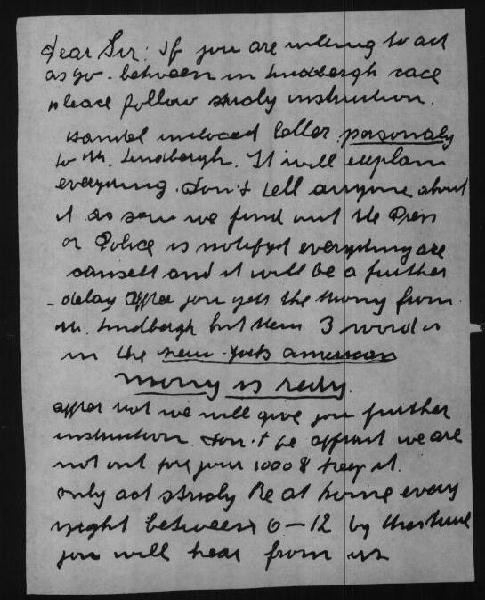
The kidnapper agreed by sending the following letter to Condon:
Dear Sir: If you are willing to act as go-between in Lindbergh cace please follow stricly instruction. Handel incloced letter personaly to Mr. Lindbergh. It will explain everything. Don’t tell anyone about it. As soon we found out the Press or Police is notifyed everythign are cansell and it will be a further delay.
Affter you gett the mony from Mr Lindbergh put these 3 words in the New York American
MONEY IS REDY
Affter notise we will give you further instruction. Don’t be affrait we are not out fore your 1000$ keep it. Only act strickly. Be at home every night between 6-12 by this time you will hear from us.1
More Hands In The Investigation
Colonel Lindbergh approved this arrangement. On 10 March 1932, the $70,000 ransom was placed in Dr. Condon’s custody. He promptly began communicating with the kidnapper through coded newspaper messages, signing them with the alias “Jafsie.”
On the evening of 12 March, around 8:30 p.m., Dr. Condon’s telephone rang with an anonymous call. Shortly thereafter, a taxicab driver named Joseph Perrone delivered the fifth ransom note to him, explaining he had received it from a stranger he couldn’t identify.
The note directed Dr. Condon to search beneath a stone at an abandoned stand located approximately 100 feet from a remote subway station, where he would discover further instructions.
Condon retrieved the sixth note as directed. Its instructions led him to Woodlawn Cemetery at the intersection of 233rd Street and Jerome Avenue, where he encountered a man who identified himself only as “John.”
Click here to view all the ransom notes.
False Leads
At this encounter, they negotiated the ransom down to $50,000. Condon handed over the money and received two things in return: a written receipt and a thirteenth note stating that the Lindbergh baby could be recovered from a boat called “Nellie” off Martha’s Vineyard, Massachusetts.
After the exchange, the mysterious man disappeared into the wooded area to the north of the park. The next day’s search of the Martha’s Vineyard waters yielded nothing—no boat named “Nellie,” no Charles Jr.
Charles Is Found
William Allen, riding alongside driver Orville Wilson in their delivery truck, stumbled upon a grim discovery on 12 May 1932. Just yards from the highway near Mount Rose in Mercer County, partially covered by soil and in advanced decay, lay the remains of the Lindbergh infant. The makeshift grave site was less than five miles from the family’s estate, where the child had been taken months earlier.

The remains showed severe head trauma, including a fracture and other significant damage. Following identification, the body was cremated in Trenton, New Jersey, on 13 May 1932. According to the Coroner’s findings, the child had been deceased for approximately two months.
Charles Jr. had been dead the entire time they searched for him.
The Media Frenzy
The Lindbergh case didn’t just change crime reporting—it blew it sky-high like a champagne cork at a wedding! Journalists didn’t merely flock to the Lindbergh estate; they descended like caffeinated vultures, transforming a family tragedy into America’s hottest ticket.
Reporters crawled through bushes, impersonated delivery boys, and one allegedly disguised himself as a potted plant—all to catch a glimpse of the grieving parents or snag a scoop about baby Charlie’s missing teddy bear. The coverage wasn’t just relentless—it was a media tornado that swept up the nation in its dizzy, ink-stained vortex.
This media tsunami whipped the public into a frenzy of amateur sleuthing that would make Sherlock Holmes reach for his opium pipe. Housewives claimed psychic visions of the baby, while barbers swore their customers resembled the kidnapper’s composite sketch.

Under the glare of twenty-four-hour news coverage, detectives felt the weight of an entire city’s expectations bearing down on them. Americans wanted justice— and they wanted it yesterday. The pressure to deliver quick answers pushed investigators into corners they might otherwise have approached with more caution.

When case details inevitably slithered into reporters’ ravenous little paws—like chocolate bars into the hands of a kindergartner on a sugar high— the investigation exploded into a three-ring circus of chaos. Detectives and public information officers performed their daily high-wire act without a net, frantically juggling which juicy tidbits to toss to the media piranhas and what information to keep closed.
The Investigation: A Shift in Dynamics
As the investigation unfolded, it became evident that the involvement of a high-profile figure such as Charles Lindbergh significantly affected the proceedings. Lindbergh’s celebrity status allowed him to exert influence over the investigation in ways that would be unthinkable today.
Lindbergh—America’s darling turned rogue detective—stormed through the investigation like a hurricane in wingtips, often bypassing law enforcement protocols. He communicated directly with potential informants and even offered large sums of money for information, thereby contributing to the investigation’s chaotic nature.

His status put immense pressure on authorities to resolve the case quickly, compromising investigative integrity. The focus shifted from methodical police work to a more sensational approach driven by public sentiment.
The Criminal Justice System: A New Precedent
The investigation ultimately snared Bruno Richard Hauptmann, a Bronx carpenter with a thick German accent and a penchant for homemade ladders, who found himself convicted of murder in 1935 and catapulted to infamy!

Courtroom Drama
The trial exploded into a three-ring media circus—complete with souvenir vendors hawking miniature kidnapping ladders outside the courthouse—while inside, the judge desperately banged his gavel like a man trying to hammer down a possessed jack-in- the-box as reporters practically swung from the rafters for the perfect scoop!
The case shattered legal norms like glass beneath a hammer, unleashing a firestorm of debate over the media’s toxic influence on trials and igniting desperate calls for radical judicial reform.

Public faith in justice didn’t merely erode—it collapsed catastrophically as the world watched reporters transform courtroom proceedings into a blood-soaked spectacle, proving once and for all how media vultures could devour the very foundation of American jurisprudence.
Click here to read the Testimony of John F. Condon
Final Thoughts
The tragic murder of Charles Lindbergh Jr. not only altered the lives of the Lindbergh family but also reshaped the way the media interacts with criminal investigations. As we reflect on this case, we are reminded of the profound impact that public figures can have on the judicial process and the ongoing fascination with conspiracy theories that continue to shroud this dark chapter of American history.
The Lindbergh case invites us to consider how far we’ve come—and how far we have yet to go—in our quest for truth and justice.
Until next time, Keep Reading and Stay Caffeinated.
For those hungry to explore more, click below to find additional readings:

Lindbergh. Few American icons provoke more enduring fascination than Charles Lindbergh—renowned for his one-man transatlantic flight in 1927, remembered for the sorrow surrounding the kidnapping and death of his firstborn son in 1932, and reviled by many for his opposition to America’s entry into World War II.

Anne Morrow Lindbergh: Her Life. Anne Morrow Lindbergh has been one of the most admired women and most popular writers of our time. Her Gift from the Sea is a perennial favorite. But the woman behind the public person has remained largely unknown. Drawing on five years of exclusive interviews with Anne Morrow Lindbergh as well as countless diaries, letters, and other documents, Susan Hertog now gives us the woman whose triumphs, struggles, and elegant perseverance riveted the public for much of the twentieth century.
Subscribe below to stay up to date on myths, legends, mysteries, and the chaos of history.

If you’re looking for your next favorite read, I invite you to check out my series, The Raven Society. This spellbinding historical fantasy series takes us on a heart-pounding journey through forgotten legends and distorted history. Uncover the chilling secrets of mythology and confront the horrifying truths that transformed myths into monstrous realities. How far will you go to learn the truth?
The Writer and The Librarian (Book 1):
Signed copies at:
https://rlgeerrobbins.com/product/the-writer-and-the-librarian-the-raven-society-book-1/
Explore more blogs here:
Footnotes:
Sources:
lindberghkidnappinghoax.com/ransom.html
Kidnapping and Trial | Minnesota Historical Society