
This post contains some affiliate links
Friends,
My husband and I love watching the series Vikings on Netflix. We have a habit of starting a series and pausing halfway through because something else has caught our eye. Still, we keep coming back to the story of Ragnar Lothbrok, Lagertha, Bjorn, Rollo, and devilish Englishmen and Frenchmen who are really challenging the theory of Christian charity.
Between the fighting, backstabbing, manipulation, and family intrigue, it is a story that captivates viewers, making them want to know more about the people described as ‘Vikings.’

Now I will admit, the show’s creator, Michael Hirst, used some creative liberties when building the storyline, and there are some points where the timeline is not timelineing- but overall it is an excellent introduction to the sagas of Norse heroes and a different viewpoint of Anglo-Saxon England and its quest for a unified country.
Lack of ‘Written Proof’

It is important to note that most of the ‘historical data’ that we have on Norsemen of early medieval Scandinavia comes from oral tradition, written down years after the events occurred. Still, it is generally accepted that the Viking Age was from 800 to 1050 CE, or what we commonly refer to as the Middle Ages.
One of the key players in Vikings has caught the eye of the viewers, and his character has sparked an international interest in Paganism, Asatroism, Heathenism, and even Wicca- Flóki Vilgerðarson.
Flóki- the Viking version of Jack Sparrow with smudged eyeliner, a tendency to speak in riddles, and the uncanny ability to move his body like he is drifting on a breeze has quickly become one of the favorite characters of the series. I am impressed with his loyalty to the Gods, his eccentric and innovative mind that designs a fleet of sea-worthy boats, and his dedication to his… well, to himself.
But was Flóki a real person, or was he a creative side-story to the saga of Ragnar Lothbrok?
Well, hold on to your iced coffee, because I’m about to tell you a story that you might have heard before.
He was Real
According to Landnámabók (The Book of Settlement), Flóki Vilgerðarson, or better known as Hrafna-Flóki (Ravens-Floki), was the second Norwegian Viking to arrive in Iceland. According to the medieval Icelandic written work, Flóki heard about the dangerous and captivating land from a Swedish Viking, Garðar Svavarsson.
Further research into the history and genealogy of Iceland’s beginnings reveals that Flóki is credited with giving the country its name. According to legend, he climbed one of the mountains in Vatnsfjörður and peered north into the abyss of snow and a vast fjord filled with ice.

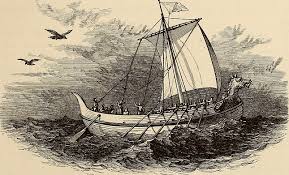
But how did Flóki get there? By boat, of course, and that’s where the story gets interesting. On his initial trip to Iceland with his family, Flóki took three ravens with him to release, serving as a sort of old-school GPS system. One raven flew to the Faroe Islands, one flew up into the sky and immediately returned to the safety of the boat, but the third one… that one flew off into the sunset.
Which meant there was land somewhere up ahead.
The family ended up spending two winters in Iceland at Vatnsfjörður fjord in the Westfjords. As you can imagine, winters in Iceland are harsh, and the family ultimately lost their livestock during the first winter. However, they persisted and stayed another year in Borgarfjörður fjord in West Iceland before heading home to Norway.
Years later, Flóki returned to Iceland and settled in Skagafjörður, a fjord in Northern Iceland, where he remained until his death. His land was called Mór in Flókadal, which was later divided into Ysta-Mó, Mið-Mó, and Syðsta-Mó. Today, a memorial to Floki is located near Ysta-Mó in Skagafjörður Fjord, in North Iceland.
Who’s telling the truth?
As you can imagine, I was interested in reading the story about Flóki’s travels to Iceland, but I couldn’t help but compare it to the biblical story of Noah and the Great Flood. Was it just a coincidence that there are two stories so similar, or had one borrowed from the other?
It is important to note that the earliest preserved version of Landnámabók was written after the arrival of Christianity in Iceland. There are a few historians who believe that some of Iceland’s early history may have been written to tie Iceland to biblical lore. However, as I quickly mentioned before, the use of birds to help ‘find’ land was a traditional method for our seafaring explorers.

It is possible that Noah and Flóki employed the same methods at different times. It does lend credibility to both stories, and in my humble opinion, neither culture ‘stole’ it from the other. It’s just an interesting coincidence.
Final Thoughts
As with all things historical, this was just a flea bite on the arm of the life of the Vikings. So many side stories need to be explained to better understand why the hell anyone would get into a long boat, sail into the middle of the ocean, and hope to find land at some point. All without coffee, I might add. However, that will be a story for another day.
Flóki and his family were explorers, willing to risk everything for a life they wanted to live. It’s a testimony to the Viking spirit and their love of death-defying adventure. And while the Netflix series might have portrayed his life a little differently than reality, it is important to remember that Flóki Vilgerðarson was a real person who had a profound impact on history.
For those hungry to explore more, click below to find additional readings:

Embers of the Hands: Hidden Histories of the Viking Age. This is the history of all the people―children, enslaved people, seers, artisans, travelers, writers―who inhabited the medieval Nordic world. Encompassing not just Norway, Denmark, and Sweden, but also Iceland, Greenland, the British Isles, Continental Europe, and Russia, this is a history of a Viking Age filled with real people of different ages, genders, and ethnicities, as told through the traces that they left behind.

Uncovering Vikings History: A Guide Into Vikings’ Exploration, Culture, Historic Battles and Their Legendary Warriors. You may have a stereotype of a Viking ingrained in your mind – one of pillaging, killing, and looting. But there’s much more to this fascinating group than brute force and violence. Get to know the Vikings beyond the tales of terror and destruction. You’ll be surprised at what you will discover.
Until next time, Keep Reading and Stay Caffeinated.
Subscribe below to stay up to date on myths, legends, mysteries, and the chaos I call my life.

If you’re looking for your next favorite read, I invite you to check out my book, The Raven Society. This spellbinding historical fantasy series takes us on a heart-pounding journey through forgotten legends and distorted history. Uncover the chilling secrets of mythology and confront the horrifying truths that transformed myths into monstrous realities. How far will you go to learn the truth?
The Writer and The Librarian (Book 1):
Signed copies at:
https://rlgeerrobbins.com/product/the-writer-and-the-librarian-the-raven-society-book-1/
Explore more blogs here:


What are your thoughts?