
This post contains some affiliate links
Friends,
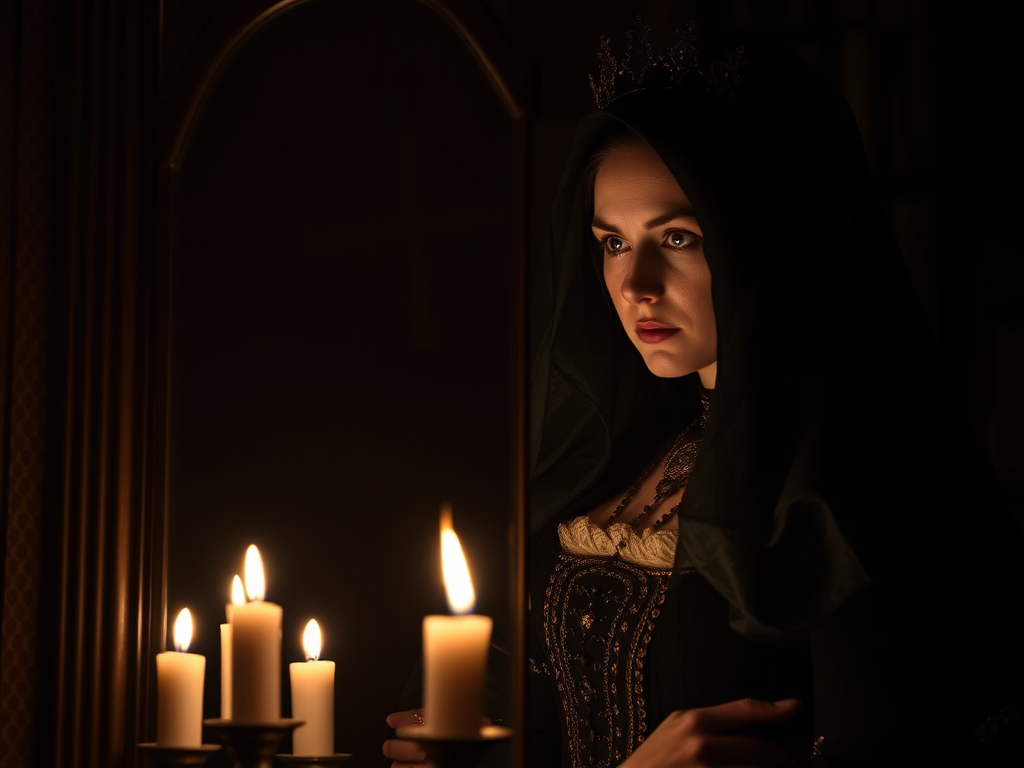
You stand in a pitch-black room, the mirror a void before you. A lone candle gutters between your white-knuckled fingers, casting your face in shadows. Your voice scrapes out: “Bloody Mary.” Your heart hammers. “Bloody Mary.” Sweat beads on your upper lip. “Bloody Mary.” The final syllable hangs in the suffocating silence. You freeze, lungs burning, eyes wide, certain that something in the darkness has just shifted.
Has Bloody Mary come?
The Many Faces of a Queen

Queen Mary I presents a complex persona. On one side of the triangle, she is the unfortunate daughter of Henry VIII, exiled from the royal court and unable to be by her cherished mother, Queen Catherine, during her final moments. Stripped of her place in the line of succession and her title as Princess of Wales, she was compelled to serve her younger sister, Princess Elizabeth, who was declared to be the future monarch of England.
The birth of Edward—King Henry VIII’s only son with his third wife, Jane Seymour—briefly restored Mary to royal favor. Second in line to the throne, she dared hope for reconciliation with her father’s house. But when young King Edward, on his deathbed, bypassed her claim and declared Lady Jane Grey his successor, Mary’s tenuous connection to the crown seemed irreparably severed. The tapestry of royal succession, which had so often unraveled and rewoven throughout her life, appeared to have cut her thread entirely.
Or will she?
The Battle of Two Queens
We then encounter the determined and strategic future queen as she leads her nation against the sitting monarch, Queen Jane. She rides into London, greeted by the cheers of her fellow countrymen and women, who have eagerly awaited justice for the rightful Princess of England.
She vows to become the ‘Mother of England,’ a role the people yearned for following the tumultuous reign of King Henry VIII, the unexpected death of King Edward, and Queen Jane’s brief 9-day rule that nearly sparked a civil war.
Then she transforms once more, becoming the figure we now call Bloody Mary. This was the queen who, in her brief five-year rule from 1553 to 1558, ordered the execution of nearly 300 individuals. Their offenses? Committing heresy and refusing to convert or support her efforts to return England to Catholicism.
Five Years and a Hundred Lifetimes

Unfortunately, Queen Mary I’s reign was relatively short, and therefore, only the most gruesome and sensational aspects are remembered. However, we would be remiss if we didn’t highlight the positives of her rule.
While records will leave us to believe otherwise, Queen Mary I was popular. Thousands of people had supported her as the daughter of King Henry VIII and did view her as the rightful Queen of England. A role that had never been acknowledged in England prior.
However, that is where her rule as a ‘Beloved Mother’ ends and her reign of terror starts.
What Goes Up Must Come Down

In 1554, Queen Mary I married Philip II of Spain to bolster England’s alliance with Spain and ensure a Catholic successor. Nonetheless, this union was met with widespread disapproval among the English populace and failed to achieve its political objectives.
Economic turmoil shadowed Mary’s time on the throne, as rising prices and faltering commerce left her administration grappling with financial chaos. Despite efforts to stabilize markets and extend aid to the destitute, her policies proved inadequate against the tide of hardship sweeping through the realm.
Mary’s marriage to Philip entangled England in his Spanish conflicts, dragging her nation into war with France. Mary and her council were also worried that helping the Spanish might lead to England being denied grain and wool from France.
The harvests in 1555 and 1556 were especially poor, causing food shortages and price increases due to scarcity. Therefore, it was essential to continue trading with France to ensure England’s food supply.
Additionally, Mary’s actions created a rift with Pope Paul IV, undermining the delicate bond she had painstakingly rebuilt between England and the Catholic Church.
Queen Mary I ultimately sided with her husband’s political desires and declared war on France. The consequences of this conflict would cast a long shadow over her legacy.
Bloody Mary
From 1555 to 1558, she ordered the execution of more than 280 individuals who opposed her religious views by burning them at the stake. Among the most notable of these executions were those of Archbishop Thomas Cranmer, Bishop Hugh Latimer, and Bishop Nicholas Ridley.
What is important to note here is that while executions were common during this time, even considered to be a family affair, these were not normal executions. They were burning.

Being burned alive is probably one of the most horrific ways to go. The fire quickly consumes and damages both the epidermis and the layer beneath it. This immediate burning causes intense pain because the nerve endings in the skin are damaged.
As a burn advances, heat causes the soft tissues to contract, leading to muscle and fat shrinkage and the typical “pugilistic stance” (boxer’s posture). The intense heat also impacts internal organs, causing them to shrink and eventually malfunction due to thermal damage and fluid loss.
Inhaling hot gases and smoke can harm the respiratory tract, leading to swelling or bleeding of the mucous membranes and potentially causing respiratory failure and suffocation. Severe burns trigger an inflammatory response that causes capillary leakage, leading to substantial fluid loss and potentially reducing blood volume.
Pregnancy Claims
Shortly after getting married, the thirty-seven-year-old queen announced she was pregnant. As her due date neared, Mary secluded herself in her chambers at Hampton Court to prepare for the birth. On April 30, 1555, news spread that the queen had given birth, leading to jubilant celebrations in the streets.
However, it soon became apparent that this was incorrect. The doctors claimed there had been an error in calculating the date, and her attendants continued to maintain the facade.
Mary clung to the belief of her pregnancy even as she retreated from court life. Ladies-in-waiting found her curled on floor cushions for hours, knees tucked beneath her chin—a posture that contradicted her supposed condition. Her skin took on a waxy pallor; her eyes grew distant with unspoken fears.
Only by late May did she surrender to the truth when her swollen abdomen finally receded.

Though her physical health returned, the charade continued until July, when she ordered the court’s relocation to Oatlands, ostensibly to cleanse Hampton Court—but truly to wash away all evidence of what physicians would later recognize as pseudocyesis: a body manifesting the deepest wishes of a desperate mind.
Death of a Queen
During the spring and summer of 1558, Mary suffered from melancholia and insomnia. By August, she developed a mild fever and dropsy, prompting her relocation from Hampton Court to St. James Palace due to her serious condition.
In September, Mary’s health deteriorated further with a high fever, headaches, and bouts of confusion, coupled with nearly total vision loss. Her illness followed a pattern of falling into a fever for several days, then temporarily recovering. Her depression intensified, exacerbating her overall condition.
In early November, her condition showed some improvement. On the 8th, she consented to appoint Elizabeth as her successor and then faced death with bouts of convulsions and extended spells of unconsciousness.
As her strength dwindled further, nobles, officials, and household officers started abandoning St. James for Hatfield, where Elizabeth was residing. She had become essentially blind and was unable to read anymore.
In the predawn darkness of November 17, Mary received the sacrament of Mass. As the clock crept toward five, her breathing slowed and then ceased altogether, her face so serene in repose that the household staff believed her condition had improved. Only the physician, noting the stillness beneath his fingertips as he sought her pulse, understood she had slipped beyond their reach.

The reign of Bloody Mary had finally come to an end.
Final Thoughts
Say “Queen Mary I” at a dinner party and watch the momentary confusion flicker across faces. Say “Bloody Mary” instead and recognition dawns immediately, though what’s remembered is only the shadow she cast, not the woman herself. Behind that grim nickname stood a queen whose childhood traumas and adult disappointments had carved away at her capacity to govern with the steadiness England required.

As this historian sees it, Queen Mary’s notorious bloodshed stemmed from deep wounds: her mother Catherine’s humiliation, her disinheritance despite being Henry VIII’s firstborn, and the steep climb she faced as England’s first sovereign queen in a realm where crowns belonged to men.
I cannot overlook the bloodshed Queen Mary I brought upon England, yet I find myself pitying the abandoned child beneath the crown.
How cruel that young Mary was raised to believe in her divine right to rule, only to watch that birthright become merely another chess piece in the great game of succession. Even her final victory proved hollow; her husband, Philip, wielded her like a sword for Spain’s interests, then left her to face death’s cold embrace without having tasted the warmth of genuine affection.
However you choose to view Queen Mary I’s life, do so with a full understanding of what led to her being known as Bloody Mary.
For a more in-depth look at the people who were executed, click here.
For more information on her life and death, click here.
For more information on Queen Mary, check out these books I’ve found:

The Heretic Wind: The Life of Mary Tudor, Queen of England. This is a fiction book; however, written by one of my favorite authors.

The Myth of “Bloody Mary”: A Biography of Queen Mary I of England. It is the tragedy of Queen Mary that today, 450 years after her death, she remains the most hated, least understood monarch in English history―remembered best for burning hundreds of Protestant heretics at the stake. Linda Porter’s pioneering new biography cuts through the myths to reveal the truth about the first queen to rule England in her own right.
Until next time, Keep Reading and Stay Caffeinated.
Subscribe below to stay up to date on myths, legends, mysteries, and the chaos I call my life.

If you’re looking for your next favorite read, I invite you to check out my book, The Raven Society. This spellbinding historical fantasy series takes us on a heart-pounding journey through forgotten legends and distorted history. Uncover the chilling secrets of mythology and confront the horrifying truths that transformed myths into monstrous realities. How far will you go to learn the truth?
The Writer and The Librarian (Book 1):
Signed copies at:
https://rlgeerrobbins.com/product/the-writer-and-the-librarian-the-raven-society-book-1/
Explore more blogs here:
Sources:
The Myth of ‘Bloody Mary’ | Mary I, England’s First Tudor Queen



What are your thoughts?