
Friends,
On 18 August 1934, a pivotal moment unfolded in San Francisco when 20-year-old Ann Hewitt, an heiress to a significant fortune, was admitted to a hospital for an emergency appendectomy. However, the procedure took a shocking turn; unbeknownst to her, the surgeons removed not only her appendix but also part of her fallopian tubes, leaving her unable to conceive.
Ann’s harrowing story gained national attention in 1936 when she filed a half-million-dollar lawsuit against both the surgeons and her mother. Her mother, however, maintained that her actions served the greater good, arguing that Ann was ‘feebleminded’ and thus needed protection for society’s sake.

This term, ‘feebleminded,’ resonated deeply with the American public, symbolizing the troubling intersections of control and eugenics that characterized a dark chapter in U.S. history. The case of the Sterilized Heiress not only highlighted the personal tragedy of one young woman but also brought to light the broader implications of eugenics in America’s societal landscape.
Just A Theory
Eugenics was initially hailed as a scientific answer to pressing social issues, promoting the idea of producing healthy children and fostering a robust society. While this concept sounds appealing on the surface, a closer look at its darker implementation reveals significant flaws in the underlying science.

In 1902, American biologist Charles Davenport, deeply fascinated by evolutionary studies, traveled to England to meet with Sir Francis Galton. Galton was not only a pioneering scientist—credited with establishing fingerprint identification1 and creating the world’s first weather maps—but he also proposed theories with far-reaching implications. Davenport sought Galton’s insights on hereditary genes, specifically focusing on the idea that individuals with higher intelligence should be encouraged to reproduce, while those deemed less capable should be discouraged from having children.
Galton’s theories were heavily influenced by his half-cousin Charles Darwin2, particularly the concept of “survival of the fittest.” He believed that this principle was failing to operate effectively within the human population and felt that scientific intervention was necessary. This led him to advocate for eugenics—a term derived from two Greek words meaning “well” and “born.”3
Chicken or the Egg
During an evening at Galton’s home, Davenport boldly declared his ambitious project to identify and promote the breeding of “good” genes while eliminating those considered “bad.” Armed with a letter of recommendation from Galton and significant funding from the Carnegie Institution, Davenport established his first research station on Long Island. There, he began collecting a variety of animals—chickens, goats, sheep, and others with unusual traits—and studied their offspring in search of genetic keys.
Davenport also drew on the groundbreaking work of Austrian monk Gregor Mendel, who had spent years experimenting with pea plants to understand how specific traits were inherited. Inspired by Mendel’s findings, Davenport set out to uncover the so-called “Mendelian Ratio,” hoping it would shed light on the science of heredity and propel the eugenics movement forward.
Many people recall the Mendelian ratio from their school days. If you have one parent with green eyes and another with blue, what color eyes will little Suzie have? I was never entirely sure if that was a science question or a math one, but it didn’t really matter. I usually ended up doodling a bunch of tiny eyes to keep myself entertained because I never understood why it mattered what color eyes she had.

Isolating Bad Genes
By 1906, the media had begun to spotlight the activities at Cold Spring Harbor4, elevating Davenport to a prominent figure in the burgeoning genetics movement. He believed the same crossbreeding techniques farmers used to improve crops and livestock could also be applied to humans. This belief gained traction, and in 1909, Davenport informed the Carnegie Institution that he was ready to shift his focus from animal genetics to the study of human traits.5
To initiate this ambitious project, he distributed family history questionnaires and sought records from prisons and hospitals. His rationale was clear: conducting research across generations was impractical given the constraints of a human lifespan. However, by collecting family pedigrees, he aimed to trace interconnections across families. Davenport aimed to identify traits that could be encouraged through careful breeding and to pinpoint undesirable characteristics that could be eliminated.

In essence, he envisioned a more perfect society—one with reduced poverty, fewer criminals, and diminished instances of what he termed ‘insanity.’ To achieve this, he believed it was essential to isolate the genes associated with these less-than-ideal traits, thereby justifying a radical approach to human genetics.
Supporters of the Movement
By 1910, a vibrant and influential network of scientists, reformers, and professionals was deeply engaged in national eugenics projects, actively pushing for eugenic legislation across the United States. The American Breeder’s Association (ABA), the country’s first eugenics organization, expanded in 1906 to establish a dedicated eugenics committee led by Davenport. The ABA was created to “investigate and report on heredity in the human race,” emphasizing the importance of “superior blood” and warning against the societal dangers posed by “inferior blood.” Its membership included notable figures such as Alexander Graham Bell, Stanford President David Starr Jordan, and agricultural pioneer Luther Burbank.
One pioneering organization that investigated infant mortality rates through a eugenic lens was the American Association for the Study and Prevention of Infant Mortality. They advocated for government intervention to promote the health of future generations.

Feminist reformers also played a significant role in the eugenics movement, pushing for legal reforms that aligned with their agenda. Groups such as the National Federation of Women’s Clubs, the Woman’s Christian Temperance Union, and the National League of Women Voters lobbied for eugenic reforms at both state and local levels.
Among the most prominent advocates was Margaret Sanger, a leading figure in the American birth control movement and founder of what would become Planned Parenthood. Sanger championed birth control as a way to prevent unwanted children from entering disadvantaged lives, weaving eugenic language into her arguments to further her cause. She also supported discouraging reproduction among those believed to have hereditary mental illnesses or serious physical disabilities, even endorsing sterilization in such cases.6

In the Deep South, women’s associations emerged as key players in rallying support for eugenic legal reform. Eugenicists recognized the political and social clout of southern clubwomen and effectively enlisted their help to spread eugenics throughout the region. Between 1915 and 1920, federated women’s clubs across the Deep South played a crucial role in establishing public eugenic institutions, often segregated by sex.
For instance, the Legislative Committee of the Florida State Federation of Women’s Clubs successfully lobbied for a eugenic institution for individuals with intellectual disabilities, aiming to separate men and women to prevent the birth of more “feebleminded” individuals.7
Side Note:
Sanger firmly believed that it should be up to individual women—rather than the state—to decide whether or not to have children.
A Case that Shook the Nation
The 1927 U.S. Supreme Court decision in Buck v. Bell remains one of the most notorious rulings in American legal history, as it upheld the constitutionality of forced sterilization laws rooted in eugenics.

At the heart of this troubling case was Carrie Buck, a young woman from Virginia who found herself institutionalized at the Virginia State Colony for Epileptics and Feebleminded. State officials seized on her situation to test the Virginia Sterilization Act of 1924, which permitted the compulsory sterilization of individuals deemed “feebleminded” or genetically “unfit.”
However, the truth was far more tragic: Buck had been institutionalized after giving birth out of wedlock, the result of a sexual assault by a relative of her foster parents, not because of any genuine mental disability.

In a shocking 8–1 decision, the Court ruled that Virginia had the authority to forcibly sterilize Buck without infringing on her Fourteenth Amendment rights to due process. Justice Oliver Wendell Holmes Jr. penned the infamous majority opinion, justifying this grim decision with the chilling remark: “Three generations of imbeciles are enough.”
Aftermath
The aftermath of state-run eugenics programs in the United States reveals a harrowing legacy that affected an estimated 60,000 to 70,000 individuals through forced sterilizations during the 20th century. These programs began in 1907 with Indiana’s enactment of the first sterilization law and continued into the 1970s, even though cases of coercion persisted well beyond that era.
A staggering thirty-two states adopted these eugenics sterilization laws, with California standing out as the most notorious, accounting for roughly one-third of the national total—over 20,000 sterilizations.

The targets of these programs were often the most vulnerable: individuals labeled as “feeble-minded,” mentally ill, or disabled, along with poor people, criminals, and racial minorities, including Black, Latina, and Indigenous individuals.
Final Thoughts
As we look back on the eugenics programs that scarred the United States for much of the 20th century, it’s essential to recognize the profound impact these policies had on countless lives. The forced sterilizations and discriminatory practices not only stripped individuals of their autonomy but also perpetuated a cycle of oppression that disproportionately affected marginalized communities.
The chilling reality is that these eugenics initiatives were often justified by pseudoscience and societal fears, leading to the tragic conclusion that certain lives were deemed less valuable. This raises a critical question: Who has the right to determine an individual’s worth? Every person deserves a voice in shaping their own life and future, free from government-sponsored reports that prioritize a narrow vision of societal “health” over human dignity.
The legacy of these policies serves as a stark reminder that when governments overstep their bounds, the consequences can be devastating. It is vital that we advocate for a world where every individual can make their own choices, supported by compassion and respect rather than fear and prejudice.
Until next time, Keep Reading and Stay Caffeinated.
Those hungry to learn more, check out these books:

Unfit Heiress by Audrey Farley. At the turn of the twentieth century, emboldened American women began to seek passion and livelihood outside the home. This alarmed authorities, who feared “over-sexed” women could destroy civilization, either by crossing the color line or passing their evident defects on to their children. Set against this backdrop, The Unfit Heiress chronicles the fight for inheritance between Ann Cooper Hewitt and her socialite mother Maryon, who had her daughter sterilized without her knowledge. A sensational court case ensued, and powerful eugenicists saw an opportunity to restrict reproductive rights in America for decades to come.
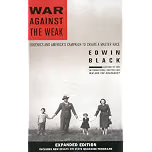
War Against the Weak: Eugenics and America’s Campaign to Create a Master Race by Edwin Black. War Against the Weak is the gripping chronicle documenting how American corporate philanthropies launched a national campaign of ethnic cleansing in the United States, helped found and fund the Nazi eugenics of Hitler and Mengele — and then created the modern movement of “human genetics.” Some 60,000 Americans were sterilized under laws in 27 states.
Subscribe below to stay up to date on myths, legends, mysteries, and the chaos of history.

If you’re looking for your next favorite read, I invite you to check out my series, The Raven Society. This spellbinding historical fantasy series takes us on a heart-pounding journey through forgotten legends and distorted history. Uncover the chilling secrets of mythology and confront the horrifying truths that transformed myths into monstrous realities. How far will you go to learn the truth?
The Writer and The Librarian (Book 1):
Signed copies at:
https://rlgeerrobbins.com/product/the-writer-and-the-librarian-the-raven-society-book-1/
Explore more blogs here:

Lizzie Borden- Family Secrets, and the Crime of the Century
In 1892, Fall River, Massachusetts, was rocked by the infamous double murder of Andrew and Abby Borden, which led to Lizzie Borden’s sensational trial. The case highlighted societal tensions regarding class, gender, and perceptions of femininity in America.


The Rosenberg Case: Espionage and Justice in Cold War America
The executions of Julius and Ethel Rosenberg in 1953, accused of espionage, ignited controversy regarding justice, loyalty, and their roles during the Cold War, with ongoing debates over Ethel’s involvement. What do you think? Guilty or Not?

Unnamed and Unseen: The Haunted Legacy of Leprosy in America
Friends, Welcome, dear readers, to a fascinating journey into the often-overlooked history of Leper Homes in the United States. This narrative transcends mere historical footnotes; it delves into the intricate interplay of fear, isolation, and the ongoing battle against stigma. Settle in as we navigate the shadows of the past, uncovering the stories of those…
Something went wrong. Please refresh the page and/or try again.
Footnotes:
- In 1880, physician Henry Faulds asked Charles Darwin for help documenting the intriguing properties of fingerprints. Faulds suspected that no two people share the same fingerprints, but he needed help proving it. Although Darwin was too old to take on the project, he recommended his younger cousin, Francis Galton. Galton embraced the challenge and conducted a series of empirical studies that confirmed Faulds’ hypothesis: indeed, no two individuals have identical fingerprints, and these unique patterns remain largely unchanged throughout a person’s life. In the process, Galton also created the first systematic approach to classifying and identifying fingerprints. He published his groundbreaking findings in his 1892 book, Fingerprints, which laid the foundation for the science of fingerprint analysis. ↩︎
- They shared the same paternal grandfather, the physician and polymath Erasmus Darwin. ↩︎
- Eu (εὖ): A prefix meaning “good,” “well,” or “good in stock.”
Genēs / Genos (γενής / γένος): A root meaning “born,” “birth,” or “race/heredity.” ↩︎ - CSHL’s research faculty still survives today and boasts a remarkable legacy, having made some of the most groundbreaking discoveries in molecular biology and genetics. With eight Nobel Prize winners, CSHL thrives today through 50 dynamic faculty members who lead innovative laboratories across a diverse array of fields—many of which intersect in exciting ways. Thomson Reuters’ Essential Science Indicators ranks CSHL in the top 1% of institutions for research citations, with its faculty standing among the top three for their influence in molecular biology and genetics. ↩︎
- Several corporate foundations heavily funded the American eugenics movement, including the Carnegie Institution, the Rockefeller Foundation, and the Harriman railroad fortune. ↩︎
- Sanger endorsed the 1927 Buck v. Bell decision, in which the U.S. Supreme Court ruled that states could forcibly sterilize people deemed “unfit” without their consent. ↩︎
- The segregation law established an “Institution for the Care of the Epileptic and Feeble-Minded,” which resulted in the creation of a “Farm Colony” designed to curb “the propagation of future degeneracy and dependency through eugenic segregation.” The statute mandated that the colony be structured to ensure these individuals would not reproduce, relieving communities and the state of the significant economic and moral burdens associated with their existence (Larson, Sex, Race, and Science, p. 68). ↩︎
Resources:
Charles B. Davenport, William E. Castle, and the International Eugenics Movement. Radcliffe Institute for Advanced Study at Harvard University. Accessed 1 Sept 2026
Charles B. Davenport. Cold Spring Harbor Laboratory. Accessed 1 Sept 2026.
To Catch a Thief: The Psychology of Fingerprints. American Psychological Association. Accessed 2 Sept 2026.
The Early History of the Infant Mortality Rate in America: “A Reflection Upon the Past and a Prophecy of the Future”. American Academy of Pediatrics. Accessed 8 Sept 2026.
What Extent was the Relationship Between Feminists and the To What Extent was the Relationship Between Feminists and the Eugenics Movement a ‘Marriage of Convenience’ in the Interwar Years? Journal of International Women’s Studies. Accessed 10 Sept 26.
Buck v. Bell, Supreme Court of Appeals of Virginia, Brief for Appellee, September 1925. Library of Virginia. Accessed 10 Sept 2026.
The Supreme Court Ruling That Led To 70,000 Forced Sterilizations. Health News : NPR. Accessed 10 Sept 2026
Sterilization Act of 1924. Embryo Project Encyclopedia – Arizona State University. Accessed 10 Sept 2026.
Emma, Carrie, Vivian: How A Family Became A Test Case For Forced Sterilizations. The Eugenics Movement And Forced Sterilization : NPR. Accessed 10 Sept 2026.
“Three Generations of Imbeciles are Enough” — The Case of Buck v. Bell. The Case of Buck v. Bell – Education Updates. Accessed 10 Sept 2026.
Finding Carrie Buck. American Experience | Official Site | PBS. Accessed 10 Sept 2026.
Eugenics: Compulsory Sterilization in 50 American States. University of Vermont. Accessed 10 Sept 2026.
Eugenics on Trial: The Sterilization of Ann Cooper Hewitt. National Humanities Center. Access 8 Sept 2026.