
This post contains some affiliate links
Friends,
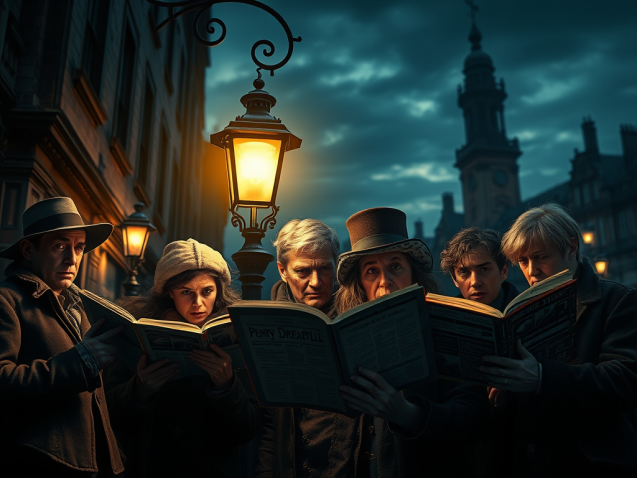
Today, we’re taking a thrilling plunge into the murky waters of Victorian literature to explore the captivating world of Penny Dreadfuls. These sensational stories were not just cheap reads; they were cultural phenomena that stirred imaginations and ignited debates across the working-class streets of 19th-century Britain.
Buckle up as we unravel their importance and highlight three of the most popular tales that kept readers on the edge of their seats! Or as I like to call them- the original social media trends.
What were the Penny Dreadfuls?
Penny Dreadful’s held up a funhouse mirror to Victorian anxieties—where pickpockets lurked in every shadow, vampires might seduce your sister, and women were beginning to demand the vote (horrors!). For just a penny, any factory worker could safely experience the delicious thrill of being stalked by Spring-heeled Jack while actually nestled in their cramped but monster-free lodgings. These gloriously lurid rags, with their “TO BE CONTINUED” cliffhangers leaving heroines dangling over precipices for a week, essentially invented binge-reading long before Netflix made binge-watching a national pastime.
Contrary to popular belief, Penny Dreadfuls weren’t single publications but an entire underground literature—cheap, ink-smudged pamphlets sold weekly for just a penny. These lurid serials— also known as “Penny Bloods” or “Penny Awfuls “1—featured everything from vampiric aristocrats to murderous barbers, from grave-robbing doctors to masked highwaymen stalking foggy London streets.
Most Popular Headlines
Some of these characters you might have stumbled across in those late-night documentaries you pretend not to binge-watch—the veritable Debrett’s Peerage of British serial killers, those tea-sipping psychopaths and council estate Hannibal’s who occupy that peculiar corner of fame where notoriety meets morbid fascination.
But let’s take a look at some of the more popular stories that generated global interest.
The Murderous Tale of Sweeney Todd
Step right up and prepare for a chilling tale from the pages of the Penny Dreadfuls, where the infamous Sweeney Todd carved his way into the public imagination! Originating in 1846, the serialized story of the Demon Barber of Fleet Street by James Malcolm Rymer2 captivated readers with its blend of horror, dark humor, and social commentary.

The narrative thrusts us into the grime-slicked gears of Victorian poverty, revealing how Sweeny Todd—a man once guided by principle—degenerates into a wild-eyed murderer who pockets his victims’ watches and coins like macabre souvenirs of his descent. His sanity goes spectacularly rotten in a city where factory smokestacks belch darkness at noon, and children lose fingers to looms for three pennies a day.
Sweeney Todd’s razor-sharp quest for vengeance—slicing throats of London’s elite faster than Mrs. Lovett could say “meat pie”—turns Victorian justice on its powdered wig. While bewigged judges sentenced children to hanging for pinching apples, our barber-turned-butcher devised his own peculiar legal system: a penny shave, a pulled lever, and whoosh!
Down the chute to pastry-encrusted judgment. His bloodthirsty barber chair (patent pending) delivered more swift justice than the Old Bailey ever could, though admittedly with questionable jurisprudence and absolutely horrific hygiene standards.
Obsession to Confession
Todd’s obsession consumes him, clouding his judgment until that fateful day when his razor slices across the throat of a beggar woman who had been wandering Fleet Street. Only as her blood pools at his feet does he recognize the locket around her neck—the one he had given Lucy on their wedding day. The truth crashes down upon him: Mrs. Lovett’s assurances of Lucy’s suicide were nothing but calculated lies, spun to secure his broken heart for herself.
The grim illustrations and thrilling narratives not only entertained but also echoed the anxieties of a society grappling with industrialization and urban decay. Todd’s character became a symbol of humanity’s darker side, reflecting fears about morality and the desperate lengths people would go to for revenge. With each installment, the legend grew, inspiring countless adaptations in theater, film, and beyond.
Side note:
Was there ever a Sweeny Todd, “Demon Barber of Fleet Street”? Historically speaking? No. I can find no conclusive proof of his existence. But some might say it draws inspiration from a real case. In the 1800s, Joseph Fouché, who headed the Parisian police force, led an investigation into a local barber suspected of murder. The barber allegedly killed multiple victims, then enlisted his neighbor— a pastry cook—to help conceal the evidence by incorporating the human remains into meat pies sold to unsuspecting customers.3
Varney the Vampire: The First Gothic Vampire Novel
Varney the Vampire was a game-changer in the realm of supernatural fiction. First published in 1845, Varney the Vampire by (maybe) Edward Lloyd4 is the second-longest Penny Dreadful, running in 109 issues, comprising 232 chapters, and totaling just over 666,000 words. This thrilling saga introduced audiences to Sir Francis Varney, a dashing yet sinister vampire who embodied the perfect blend of horror and romance.
With his suave demeanor and supernatural powers, Varney captivated readers while also reflecting the Victorian fascination with the macabre.

Each installment was packed with nail-biting suspense, as Varney haunted the halls of an ancestral estate, leaving a trail of mystery and bloodshed in his wake. The vivid illustrations of his fanged visage enhanced his allure, making him an iconic figure in Gothic literature. Varney’s character explored themes of class, morality, and the struggle between good and evil, resonating deeply with a society grappling with its own fears and desires.
The interplay between horror and romance in Varney the Vampire helped establish the trope of the romantic vampire. Varney’s seductive nature and relationships with his victims/lovers introduced a blend of eroticism and danger that would become a hallmark of vampire literature.
This tale not only paved the way for future vampire lore but also established a lasting legacy in horror fiction.
Side note:
No one really knows who wrote Varney the Vampire. It was published by Edward Lloyd, who became well known for his penny dreadful serials and later moved into the newspaper business. Edward Lloyd didn’t allow authors to put their names on published works; thus, the mystery of who exactly penned Varney the Vampire.
The Adventures of Paul Clifford

This thrilling tale follows Paul Clifford, a gentleman turned criminal, as he navigates the seedy underbelly of London. The story’s blend of crime, adventure, and societal critique resonated with readers, making it immensely popular.
Serialized in the 1830s, this gripping story follows Paul, a charming gentleman turned criminal, as he navigates the treacherous streets of London. His dual identity as a suave rogue and a thief reflected the societal tensions of the time, in which class distinctions blurred amid the chaos of urban life.
While the story was not initially published in a newspaper, its massive popularity led to numerous serializations in “penny bloods” and radical journals throughout the 19th century.
Among the tales that cemented Paul Clifford’s notoriety was his brazen theft from a merchant of considerable means. The scheme he devised displayed meticulous attention to detail. Yet, when unexpected complications arose, Clifford’s nimble mind and persuasive demeanor proved his salvation, revealing both his adaptability in crisis and his audacious spirit.
The affairs of the heart complicated Clifford’s already precarious existence. His infatuation with a wealthy, unwed woman thrust him into perilous encounters—facing down her guardian’s wrath and crossing swords with jealous competitors for her affection.
Who We Are vs. Who We Become
His narrative captivated audiences largely because of the internal conflict—the thief’s instincts pulling against the desire for redemption. Throughout his journey, crossroads appeared where the easy path backward beckoned with familiar comfort while the more challenging road forward promised only uncertain grace. It was in these moments, knife-edge decisions between who he had been and who he might become, that readers glimpsed themselves.
The series was packed with thrilling escapades, daring heists, and romantic entanglements, keeping readers on the edge of their seats. With vivid illustrations and cliffhanger endings, Penny Dreadfuls brought Paul’s adventures to life, making him a beloved antihero who embodied the era’s fascination with crime and rebellion.
The narrative also sparked discussions on morality, class, and the consequences of a life on the edge, making it more than just an entertaining read.
Side note:
Edward Bulwer-Lytton5 wrote the novel Paul Clifford (1830). It is best known for its opening line, “It was a dark and stormy night,” a fact my mother would appreciate. If you would like to read the original story of Paul Clifford, click here– Project Gutenberg has uploaded a free copy for everyone to enjoy.
Jack the Ripper’s Gruesome Glory
In the shadowy streets of Victorian London, the name ‘Jack the Ripper’ sent shivers down spines, and the Penny Dreadful eagerly seized the opportunity to weave sensational tales around this elusive killer.
Illustrated front pages depicted chilling scenes, while the stories delved into gory details, often embellishing the horror for dramatic effect. With titles like “The Ripper’s Revenge” and “Mysteries of the East End,” these articles not only entertained but also fed the public’s insatiable curiosity and fear. The Ripper became a cultural icon, a figure of fascination that sparked endless speculation and conspiracy theories.

Robana Picture Library/age fotostock
The Ripper’s victims—mostly “unfortunates” who sold their bodies for a few pence and a swig of gin—became pawns in a Victorian morality play where the press cast them as both pitiful doves and deserving sinners. The Illustrated Police News plastered lurid woodcuts of slashed throats across penny papers that proper ladies pretended not to read while secretly devouring every gory detail.
Meanwhile, gentlemen in top hats debated whether “loose women” who wandered Whitechapel’s fog-choked alleys after dark were simply reaping what they’d sown—a convenient fiction that let them clutch their watch chains a bit tighter while assuring their corseted wives that murder only happened to “those kinds of people.”
Death to Dollars
Penny Dreadfuls flew off the presses faster than newsboys could hawk them, their lurid illustrations featuring cloaked figures with impossibly long fingers. At dinner parties, duchesses and chimney sweeps alike proposed their pet theories—perhaps he was the Queen’s son gone mad, or a butcher with a grudge against womankind, or even a vampire bat in human clothing. Amateur sleuths armed with magnifying glasses and deerstalker hats prowled Whitechapel, hoping to catch the monster and claim both glory and the substantial reward.
Side Note:
The British Home Office—those stiff-collared gentlemen of Westminster refused to offer a government reward. Their reasoning? A delightfully Victorian concern that rewards would tempt the lower classes into fabricating evidence or, worse yet, hoarding valuable clues until the price was right.
Meanwhile, the City of London Police dramatically slapped down £500—enough to buy a modest house at the time.6
Not to be outdone, the Whitechapel Vigilance Committee—an assembly of shopkeepers and local citizens armed with walking sticks and righteous indignation—scraped together £50.7 Samuel Montagu, the Member of Parliament representing Whitechapel’s terrified constituents, dug into his own pockets for £100, a sum that coincidentally matched his annual expenditure on fine cigars.
Final Thoughts
Penny Dreadfuls were more than just cheap literature; they were a reflection of Victorian fears, aspirations, and the thirst for thrilling tales. Their legacy can still be felt today, influencing modern horror and crime fiction. So, the next time you pick up a scary novel or binge-watch a true crime series, remember the daring pioneers of the Penny Dreadful!
What do you think about the impact of Penny Dreadfuls on modern storytelling? Let me know your thoughts or if you’d like to dive deeper into this fascinating world!
Until next time, Keep Reading and Stay Caffeinated.
For those hungry to explore more, click below to find additional readings:

Sweeney Todd, The Barber of Fleet-Street: Vol. I: Original title: The String of Pearls. This two-volume edition presents the full version of what’s probably the most influential and notorious “Penny Dreadful” ever published: the one in which London was introduced to Sweeney Todd, the Demon Barber of Fleet Street, and his pie-selling partner-in-crime, Mrs. Lovett.

Portrait of a Killer: Jack the Ripper – Case Closed by Patricia Cornwell. Cornwell combines the rigorous discipline of twenty-first-century police investigation with forensic techniques undreamed of during the late Victorian era to solve one of the most infamous and complex serial murder cases in history.

If you’re looking for your next favorite read, I invite you to check out my series, The Raven Society. This spellbinding historical fantasy series takes us on a heart-pounding journey through forgotten legends and distorted history. Uncover the chilling secrets of mythology and confront the horrifying truths that transformed myths into monstrous realities. How far will you go to learn the truth?
The Writer and The Librarian (Book 1):
Signed copies at:
https://rlgeerrobbins.com/product/the-writer-and-the-librarian-the-raven-society-book-1/
Explore more blogs here:
Footnote:
- Penny dreadfuls | The British Library ↩︎
- James Malcolm Rymer | Research Starters | EBSCO Research ↩︎
- Sweeney Todd might have been French… or he might have been fake | All About History ↩︎
- Varney the Vampyre by James Malcolm Rymer | Research Starters | EBSCO Research ↩︎
- Edward Bulwer-Lytton | Research Starters | EBSCO Research ↩︎
- Casebook: Jack the Ripper – Daily News – 2 October 1888 ↩︎
- The Whitechapel Vigilance Committee ↩︎
Sources:
The Truth Behind the Story of Sweeney Todd
Varney the Vampire; or, the Feast of Blood | Into Horror History | J.A. Hernandez
Your guide to Jack the Ripper | HistoryExtra



What are your thoughts?