
This post contains some affiliate links
There are so many moments in history when the overall plot is well known, yet tiny details are often forgotten. My co-worker recently recommended an HBO series to me, Chernobyl, and I quickly jumped on board. For two days, I was drawn into the mystery and horror of one of the world’s most devastating nuclear power plant disasters.
True heroes emerged from the story as well. Brave souls that pushed themselves above and beyond the call of duty to save not only their country, but the world. Pilots, firemen, scientists, medical professionals, miners, and more.
I wanted to share a story about one of them because, as new documentation emerges and scientists discover surprising consequences of the Chernobyl explosion, it is time to share these stories.
Valery Legasov-
A brilliant man, at 36 he became a Doctor of Chemical Sciences; at 45, a full member of the Academy of Sciences. For his work on the synthesis of chemical compounds of noble gases, he was awarded the title of Laureate of the State and the Lenin Prize.

Yet Legasov had never specialized in nuclear science. His presence at Reactor 4 of the Chernobyl Nuclear Power Plant in Soviet Ukraine was mere happenstance—a cruel twist of fate. When disaster struck, the true experts were unreachable, scattered on their holidays. A plane stood fueled and waiting. Someone had to go.
Within half a day, this chemist found himself appointed to the government’s special commission, thrust into history’s most catastrophic nuclear accident.
First thing first…

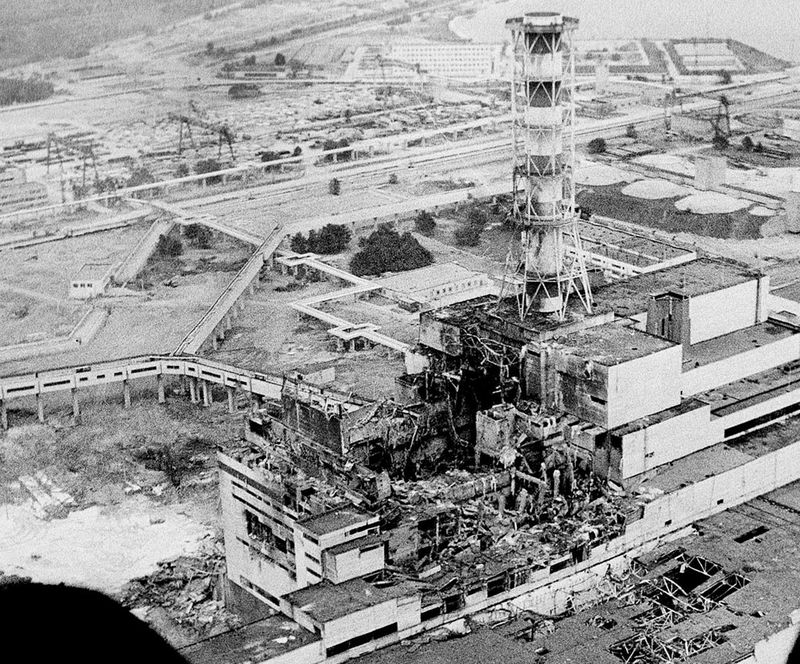
When Legasov initially arrived at the disaster site, firefighters had largely tamed the flames, but an invisible enemy still poured from the reactor’s gaping wound. The skeletal remains of Reactor 4 loomed like a monstrous sculpture, leaking death into the atmosphere.
Legasov urgently pressed Boris Shcherbina, the government commission chairman, to prioritize the evacuation of Pripyat‘s residents—a plea that finally materialized, but not until a day and a half after the reactor had torn itself apart.
A fleet of buses arrived, evacuating fifty thousand residents to safety beyond the invisible danger. In the aftermath, authorities cordoned off a thirty-kilometer radius around the reactor—a ghost territory that would remain poisoned for the next 20,000 years.
Each day, Legasov ordered a pilot to circle the facility multiple times, even as his dosimeter shrieked warnings—its needle swinging wildly into the red zone, signaling dangerous radiation levels saturating the air around them.
Despite regulations limiting personnel to two-week rotations at the disaster site, Legasov remained for four months, absorbing radiation levels quadruple the safety threshold. By early May, his body betrayed the first whispers of radiation sickness—a metallic taste that wouldn’t leave his mouth, patches of hair that came away in his comb.
Ten days later, the nausea and fatigue became constant companions.
Still, each morning he rose from his cot, hands trembling as he buttoned his shirt, driven by the knowledge that every calculation he completed might spare another family from the invisible poison saturating the air in other parts of the country.
Telling the truth…
Legasov’s heroism extended to the international stage when the International Atomic Energy Agency invited him to Vienna. Standing before the world’s nuclear oversight body, he delivered an unflinching five-hour report that attributed the catastrophe to fundamental design defects and operational missteps.
Despite pressure from Soviet authorities, he insisted on revealing the unvarnished truth rather than the sanitized narrative his government preferred.
Legasov’s report delivered a damning verdict: the RBMK reactor design suffered from fundamental instabilities that had led every nation except the Soviet Union to prohibit its use.
Despite earlier warnings about the lack of a containment structure to prevent radioactive release during accidents, Soviet authorities dismissed these concerns.

On the fateful night, the reactor fell into the hands of staff who lacked proper training and found themselves overwhelmed by equipment they barely understood.
Neglect by the scientific management and the designers was everywhere with no attention being paid to the condition of instruments or of equipment…
While the international community praised his candor, Soviet officials bristled at Legasov’s revelations. His testimony had laid bare the reactor’s fundamental flaws and the dangerous corners cut during construction—issues scientists like himself had flagged years earlier in other reactors, only to watch their warnings vanish into bureaucratic silence.
The Soviet authorities retaliated swiftly. Legasov’s once-celebrated name vanished from the scientific community’s highest honors. The Hero of Socialist Labor medal—which would have recognized his life-saving work at Chernobyl—was denied when colleagues suddenly “couldn’t recommend” him.
At the Kurchatov Institute of Atomic Energy, where he had served as Deputy Director, his scientific peers voted 129 to 100 to remove him from the Scientific and Technical Council, effectively exiling him from the institution he had helped build.
He couldn’t survive the aftermath…
Legasov’s life came to its tragic conclusion on April 27, 1988—exactly one day after the Chernobyl disaster’s second anniversary. His body, already ravaged by radiation poisoning, and his spirit, crushed by professional exile, could endure no more.
He left behind a final recording, but no note explaining why he chose to end his suffering rather than allow his family to witness his slow decline.

Fortunately, in the months before his death, Legasov meticulously documented his experiences through handwritten journals and audio tapes, leaving behind crucial firsthand testimony that would later illuminate the true extent of the Chernobyl catastrophe.
Eight years after his death, Legasov received the highest honor his country could bestow—Hero of the Russian Federation—in a decree signed by President Boris Yeltsin on September 20, 1996.
Final Thoughts
Legasov’s sacrifice represents just one chapter in the larger chronicle of those who confronted the Chernobyl catastrophe—a global tragedy whose full dimensions remained obscured for decades.
Only now, as researchers meticulously excavate the disaster’s long shadow, can we begin to assemble the complete mosaic of what truly happened and who paid the price for truth.
Legasov’s sacrifice deserves recognition—not just for him, but for his family, who watched him deteriorate. His story reveals heroism in unexpected places: in conference rooms rather than battlefields, in scientific papers rather than proclamations.
When these academics chose truth over political expediency, they faced swift punishment, but their courage ultimately altered how nations approach nuclear safety. Their rebellion wasn’t with weapons, but with facts that could no longer remain hidden and had changed the world.
Until next time, Keep Reading and Stay Caffeinated.
For those hungry to explore more, click below to find additional readings:

Midnight in Chernobyl: The Story of the World’s Greatest Nuclear Disaster. From journalist Adam Higginbotham, the New York Times bestselling “account that reads almost like the script for a movie” (The Wall Street Journal)—a powerful investigation into Chernobyl and how propaganda, secrecy, and myth have obscured the true story of one of history’s worst nuclear disasters.

Voices from Chernobyl. Composed of interviews in monologue form, Voices from Chernobyl is a crucially important work of immense force, unforgettable in its emotional power and honesty, and a National Book Critics Circle Award winner.
Subscribe below to stay up to date on myths, legends, mysteries, and the chaos I call my life.

If you’re looking for your next favorite read, I invite you to check out my book, The Raven Society. This spellbinding historical fantasy series takes us on a heart-pounding journey through forgotten legends and distorted history. Uncover the chilling secrets of mythology and confront the horrifying truths that transformed myths into monstrous realities. How far will you go to learn the truth?
The Writer and The Librarian (Book 1):
Signed copies at:
https://rlgeerrobbins.com/product/the-writer-and-the-librarian-the-raven-society-book-1/
Explore More Blogs:




What are your thoughts?