
This post contains some affiliate links
Friends,
Before the rash appears, people with smallpox experience a fever that burns them from the inside out, soaking their bed sheets and leaving them gasping for water. Their muscles ache as if beaten with clubs, and headaches pound like hammers against the backs of their eyes.
Then comes the rash—smallpox’s cruel signature—erupting first as tiny crimson pinpricks that swell into angry, pearl-sized bumps.
These fill with yellowish-white pus that gleams beneath taut, translucent skin. The pustules feel like marbles embedded deep in the flesh, each one throbbing with its own heartbeat of pain. When they multiply and merge, forming continents of agony across the sufferer’s body.
Inside the mouth, the pustules transform into ragged ulcers that make every swallow taste of blood and rot. Eventually, the pustules blacken and harden into scabs that fall away, leaving behind cratered landscapes of skin—a permanent reminder of your ordeal.
If you lived.
The Beginning
Ancient Egypt: Archaeologists discovered telltale pockmarked scars etched into the preserved skin of royal mummies, their once-regal faces forever marred by the devastating disease that ravaged the Nile Valley as early as 1500 BCE.

India and China: Yellowed Sanskrit scrolls and delicate bamboo manuscripts from the ancient East describe a “red plague” that left survivors disfigured with crater-like scars, their detailed accounts matching the horrific progression of smallpox with chilling accuracy.
Europe: The disease crept westward like a silent predator, finally sinking its claws into European populations during the 6th century CE, where it would later decimate entire villages, leaving behind graveyards filled with the unmarked tombs of its countless victims.
Scientists believe this microscopic killer first evolved to prey on human hosts between 3,000 and 4,000 years ago, making it one of humanity’s oldest and most persistent enemies.
Edward Jenner- A Name We Should All Know.
In 1796, English physician Edward Jenner observed a curious phenomenon: milkmaids who contracted cowpox appeared to be immune to the deadly smallpox virus. Already familiar with variolation—the practice of exposing patients to lesser material to prevent severe disease—Jenner hypothesized that the milder cowpox infection might confer protection against its more dangerous relative.

Eager to validate his hypothesis, Dr. Jenner extracted pus from a cowpox lesion on the hand of Sarah Nelmes, a local milkmaid, and introduced it beneath the skin of James Phipps, his gardener’s eight-year-old child. Following this procedure, Jenner deliberately exposed the boy to the smallpox virus multiple times over the subsequent months. Remarkably, young Phipps remained immune to the disease.
Jenner continued his research and, by 1801, had compiled sufficient evidence to publish his groundbreaking treatise, On the Origin of the Vaccine Inoculation. Within its pages, he documented his findings and boldly predicted that his technique would lead to “the annihilation of the smallpox, the most dreadful scourge of the human species.”
The Royal Society rejected Jenner’s manuscript despite his membership, deeming his revolutionary findings insufficiently supported by evidence. Undeterred, Jenner journeyed to London, where Sampson Low’s publishing house released his work, An Inquiry into the Causes and Effects of the Variolæ Vaccinæ, in June 1798. The volume quickly captured the imagination of London’s intellectual circles, finding eager physicians and educated aristocrats of the Enlightenment era.
New York’s Smallpox Hospital
Construction crews broke ground on 1 April 1854, at Blackwell Island’s southern tip (now Roosevelt Island), beginning work on what would become America’s first dedicated smallpox treatment facility. James Renwick, Jr.—the architectural mind behind both St. Patrick’s Cathedral and the Smithsonian Institution—designed the building in the Gothic Revival style, with its imposing silhouette rising above the East River over the next two years.

According to Untapped New York, “It was built using labor from the nearby lunatic asylum.” History of Health in New York said: “Although hard to imagine, that grim visual isn’t too far off from reality. According to Stephen Martin, member of the ‘Friends of the Ruin’, the smallpox hospital was built using ‘chain gang’ prison labor.”
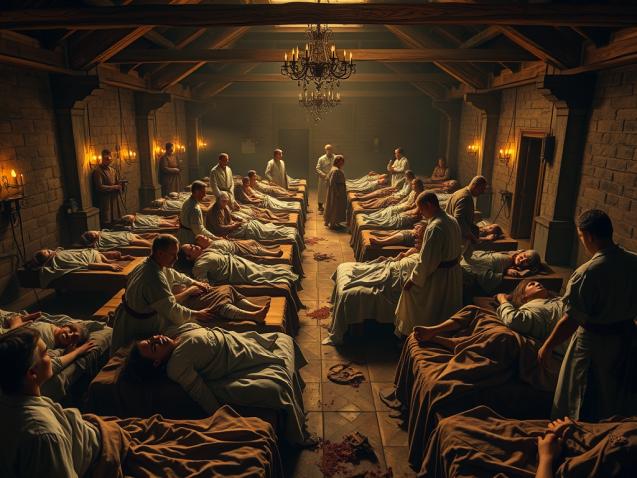
The imposing three-story structure housed up to 100 indigent patients at any given time. Those without means found themselves confined to the ground floor’s crowded wards, while those with financial resources secured private chambers in the upper reaches of the building. Whispers from the era suggest that a patient’s purse often determined their prospects for recovery more reliably than their actual condition.
The hospital received its first patients in 1856. “During the hospital’s 19-year run, it treated about 7,000 patients a year, with about 450 patients dying there annually,” reported Culture Trip. The History of Health in New York documents how coffins would be stacked visibly on the grounds, while attendants routinely dumped cremated remains directly into the flowing waters nearby.
Changing Hands
By 1875, the Sisters of Charity from St. Vincent’s had assumed control of the facility at the request of New York City officials. No longer solely dedicated to smallpox cases, the institution was rechristened Riverside Hospital—a name that acknowledged both its panoramic views of the East River and its expanded mission to treat a broader spectrum of ailments.
Once a successful vaccine was implemented in the late 1800’s, the hospital was closed and fell into disrepair.

Smallpox Today
Three hundred million people died from smallpox in the twentieth century alone. According to the CDC, although it was declared eradicated in 1980,
Smallpox research in the United States continues and focuses on the development of vaccines, drugs, and diagnostic tests to protect people against smallpox in the event that it is used as an agent of bioterrorism.- CDC
Only one other facility beyond the American laboratory is confirmed to harbor living smallpox: a Russian lab where, in September 2019, an explosion shook the building. Officials insisted the viral specimens remained secure. Despite the WHO’s advocacy for destroying these last remaining samples, international agreement on a timeline remains elusive.
Final Thoughts
In the 1900’s, smallpox ravaged humanity, devouring over 300 million souls—fathers torn from children, mothers from infants, entire villages erased. Consider this: when the century dawned, only 1.6 billion people inhabited our planet. By 1979, we numbered 4.4 billion, having somehow multiplied despite this monstrous culling, this invisible enemy that left countless faces forever scarred and bodies piled in mass graves across continents.
Those are haunting numbers.
The Smallpox hospital in New York stands like a rotting sentinel, its crumbling walls whispering a blood-chilling warning: our declaration of victory was premature. The monster we thought vanquished merely sleeps, waiting to rise again from the shadows of our complacency if we don’t do everything possible to destroy the remaining vitals.
The power remains in our leaders’ hands. Do we trust them to do the right thing?
Until next time, Keep Reading and Stay Caffeinated.
For those hungry to explore more, click below to find additional readings:

Pox Americana: The Great Smallpox Epidemic of 1775-82. A horrifying epidemic of smallpox was sweeping across the Americas when the American Revolution began, and yet we know almost nothing about it. Elizabeth A. Fenn is the first historian to reveal how deeply variola affected the outcome of the war in every colony and the lives of everyone in North America.
Subscribe below to stay up to date on myths, legends, mysteries, and the chaos I call my life.

If you’re looking for your next favorite read, I invite you to check out my series, The Raven Society. This spellbinding historical fantasy series takes us on a heart-pounding journey through forgotten legends and distorted history. Uncover the chilling secrets of mythology and confront the horrifying truths that transformed myths into monstrous realities. How far will you go to learn the truth?
The Writer and The Librarian (Book 1):
Signed copies at:
https://rlgeerrobbins.com/product/the-writer-and-the-librarian-the-raven-society-book-1/
Explore more blogs here:
Sources:
The Smallpox Hospital – History of Health in New York
Roosevelt Island Historical Society » Smallpox Hospital
On Vaccinations and the Smallpox Epidemic of 1894 | Brooklyn Public Library
Plague in China’s Dynastic Twilight – Fairbank Center for Chinese Studies




What are your thoughts?